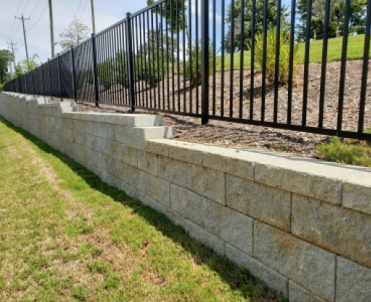
A retaining wall fifty feet from the water and a retaining wall in your backyard are not the same job — even if they look identical when they're finished. On the harbors and bays of Long Island's North Shore, a waterfront wall has to survive salt, tides, storm surge, and a permitting process that a typical backyard wall never touches. Build it like a backyard wall and the water will find every shortcut.
We build all over the North Shore — Huntington Bay, Centerport, Cold Spring Harbor, Lloyd Harbor, Northport, Oyster Bay — and a real share of that work sits close to the water. Here's what makes waterfront walls different, and what you should know before you start getting quotes.
First: a retaining wall is not a sea wall
This distinction matters more than any other, so let's get it out of the way first.
- A retaining wall holds back soil. Its job is gravity and earth pressure. Most of what we build — terraced yards, raised patios, driveway cuts — is retaining wall work, even on a waterfront lot, as long as it sits back from the water and isn't taking wave action.
- A sea wall (or bulkhead) holds back water and takes direct wave and tidal energy. These are marine structures, engineered and permitted as shoreline-hardening, and they live in a different regulatory world.
Plenty of North Shore properties need a retaining wall that happens to be near the water — terracing a sloped lawn that runs down toward the bay, for example — without needing a true bulkhead. Knowing which one you actually need is the first thing we sort out on a site visit, because it changes the materials, the engineering, and the entire permitting path.
Salt changes the materials
Salt air and salt spray are corrosive in ways that don't show up for years, which is exactly why they're dangerous — the damage is done long before it's visible.
Steel and fasteners
Anything metal near salt water has to be specified for it. Standard galvanized hardware that's fine in a backyard can corrode near the shore. On timber walls especially, the connectors and tiebacks need to be rated for a marine environment, or the wall outlives its own fasteners and comes apart from the inside.
Block and stone
Engineered concrete block systems like Cambridge and Nicolock hold up well near salt as long as the wall stays well-drained, because the threat is freeze-thaw on saturated, salty block. Natural stone is excellent by the water — it's been doing it for centuries — provided the setting and drainage are right. What you avoid is anything porous that soaks up salt water and then freezes.
Wood
Timber can work near the water, but only properly rated material with marine-grade hardware, and you should expect a shorter lifespan than block or stone in a salt environment. For a wall you want to forget about for forty years, we usually steer waterfront customers toward engineered block or stone.
Drainage matters even more by the water
Every wall we build lives or dies on drainage — and a waterfront wall has to handle more water from more directions. A high water table near the shore means the soil behind the wall can stay saturated for longer stretches. Storm events push water up from the front and dump it from above at the same time.
That means the drainage system we covered in our drainage guide isn't optional or value-engineered down near the water — it's the whole ballgame. Clean stone backfill, non-woven filter fabric, a properly pitched perforated pipe, and an outlet that genuinely flows. On a waterfront wall we often oversize all of it, because the cost of a clogged drain is so much higher when the soil is wet half the year.
Storm surge and the elevation question
The North Shore has taken real coastal flooding — Sandy is the obvious example, but ordinary nor'easters push surge into the harbors every few winters. A wall near the water has to be designed with the understanding that it may be partially submerged or take a surge load it would never see inland.
Practically, that affects how we set the base, how we backfill, and whether parts of the structure need to be engineered to handle water from the front rather than just earth from behind. It's also why a waterfront wall is one of the few situations where we'll recommend bringing in a licensed engineer even on a project that's modestly sized — the loads are simply less predictable near the shoreline.
Permits: assume you need them near the water
This is the biggest practical difference for a waterfront homeowner. A backyard wall under four feet often slides under the permit threshold. Near the water, that exemption usually doesn't apply, because you're potentially in regulated territory:
- Tidal wetlands and the NYS DEC. Work within a certain distance of tidal wetlands on Long Island can trigger New York State Department of Environmental Conservation jurisdiction, regardless of wall height.
- Town and village shoreline rules. Many North Shore municipalities — and the incorporated villages like Lloyd Harbor and Asharoken — have their own coastal and waterfront regulations layered on top of the town code.
- FEMA flood zones. If the property sits in a mapped flood zone, that affects what you can build and how.
We're not going to pretend to give you a one-paragraph permitting answer for a tidal-zone wall, because there isn't one — it depends on the specific property, the distance to the water, and which town or village you're in. What we will tell you plainly: near the water, assume you need permits, build the approval timeline into your plans, and never let a contractor talk you into skipping it. An unpermitted waterfront structure is a problem that surfaces at resale, often expensively. (Our North Shore permits guide covers the general process; waterfront just adds the coastal layer on top.)
The bottom line for waterfront homeowners
A retaining wall near the water can absolutely be done right, last for decades, and look beautiful doing it — the harbors are full of stone walls that have stood for a century. But it asks for more than a backyard wall: salt-rated materials, oversized drainage, surge-aware design, and a permitting process you take seriously from day one. The contractors who treat a waterfront wall like any other wall are the ones whose work we end up replacing.
If you've got a wall to build near the water anywhere on the North Shore, the right first step is a site visit so we can tell you what you're actually dealing with — a simple retaining wall, a regulated coastal structure, or something in between. That conversation is free, and it'll save you from finding out the hard way.