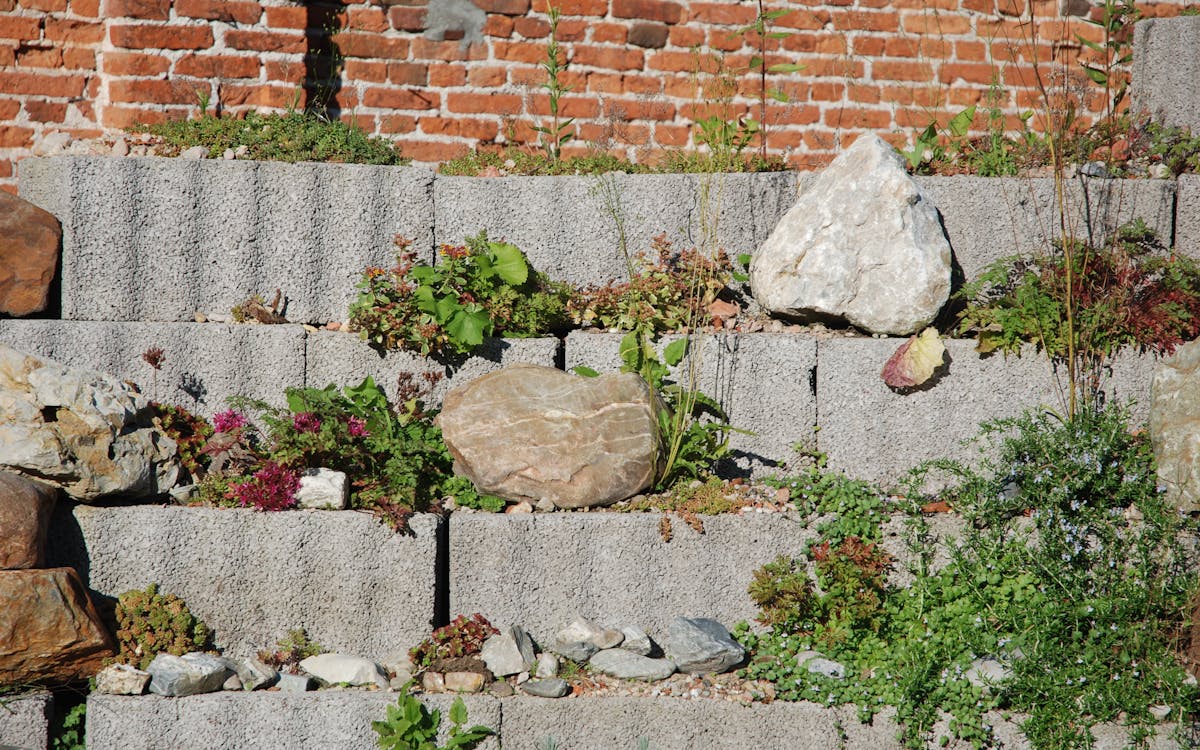
A retaining wall built for Bay Shore is not the same wall you should build in Cold Spring Harbor. The South Shore is flat sand. The North Shore is glacial till, steep grades, and clay layers that hold water for days. If your contractor doesn't know that, you have the wrong contractor.
Long Island's North Shore is geologically a leftover of the Wisconsin glaciation — the last ice age. About 20,000 years ago, the leading edge of a glacier stopped roughly along the spine of Long Island and dropped everything it had been carrying for the last few thousand miles: sand, clay, gravel, boulders, and silt, all dumped in a chaotic mix called glacial till. That mix, plus the steep ridges and ravines the ice left behind, is what gives the North Shore its character — and its retaining wall problems.
What's actually under your yard
If you dig a hole anywhere on the North Shore, you'll typically find some combination of these layers, in no predictable order:
- Topsoil (6–18 inches): the layer of organic material plants live in. Useless for structural support.
- Sandy loam: the most common subsoil. Drains reasonably well, holds shape okay, easy to work with.
- Glacial till: a chaotic mix of sand, clay, gravel, and rocks of every size. Variable strength, often hits an unexpected boulder.
- Clay lenses: layers or pockets of clay that don't drain. Often the cause of mysterious wet spots in otherwise sandy soil.
- Bedrock or compact gravel: rare in the top 10 ft on most North Shore lots, but it shows up.
What this means in practice: even two adjacent lots in Lloyd Harbor can have completely different soil profiles. We've drilled test holes 30 feet apart and found pure sand in one and dense clay in the other. That's why a real soil assessment matters more here than almost anywhere else on Long Island.
Why North Shore slopes punish bad walls
Three things make this terrain harder on retaining walls than the rest of Long Island:
1. Real elevation change
The North Shore has actual hills. The bluffs along the Sound, the moraine ridge that runs from Manhasset through Huntington and out to Stony Brook — these aren't gentle slopes, they're 20 to 60 feet of vertical drop in some places. A retaining wall here isn't a decorative garden border, it's structural.
2. Clay layers that trap water
This is the one that fails the most walls. Surface water soaks into the sandy upper soil, hits a clay layer 3–5 ft down, and instead of continuing into the ground it travels horizontally — toward and through your retaining wall area. A wall designed for "well-drained sandy soil" gets ambushed by perched water it wasn't built to handle.
This is exactly why we drill test holes before designing tall walls. If we find a clay layer, the drainage design has to compensate for it — usually with deeper drainage trenches and additional French drains uphill of the wall to intercept the water before it reaches the structure.
3. Freeze-thaw cycles
North Shore winters cycle through freeze and thaw repeatedly — sometimes twenty or thirty times a season. Saturated soil at 28°F expands. Saturated soil at 36°F contracts. Multiply that by 25 winters and you understand why under-drained walls fail in their second decade rather than their fifth.
What this means for your wall design
Building on the North Shore right means designing against the worst-case version of these conditions, not the average. Here's what changes:
Deeper, beefier base
Standard wall bases are 6 inches of compacted gravel below grade. North Shore walls — particularly anything over 4 ft — get 8–12 inches, plus we excavate below frost line (about 36 inches in Suffolk, 30 inches in Nassau) for the leading edge of the base.
More aggressive drainage
The standard 4-inch perforated pipe with 12 inches of clean stone behind the wall is the minimum. On clay-heavy or wet sites, we'll often add a second uphill French drain to intercept perched water before it ever gets to the wall.
Engineered systems by default
For tall walls, this is why we lean so heavily on Cambridge and Nicolock. Both are engineered, tested, and rated for specific load conditions — and both integrate cleanly with geogrid soil reinforcement, which is non-negotiable for North Shore walls over 4 ft.
Stone and wood with caveats
Both natural stone and pressure-treated wood walls work fine on the North Shore — but only when the height is appropriate (under 4 ft for either) and the drainage is done right. We see more failed wood walls here than anywhere else on Long Island, almost always because the original installer treated it like a flat-soil project.
Why local expertise actually matters
This is the part of the article where every contractor says "trust local experts" and most of them mean nothing by it. Here's what we actually mean.
We've drilled and built on enough North Shore lots that we have a reasonable map in our heads of where the clay layers tend to show up, where bedrock is shallow, where water tables sit high, and where the freeze-thaw is worst. We know which streets in Centerport flood and which streets in Huntington Bay don't. We know that the lots above the harbor in Cold Spring Harbor have a tricky transition between sand and till at about 8 feet down. None of this is in a textbook. All of it changes how we design and price a wall.
If you're getting quotes from a contractor whose primary market is the South Shore, ask them about the clay layer problem. The right contractor will know exactly what you mean.