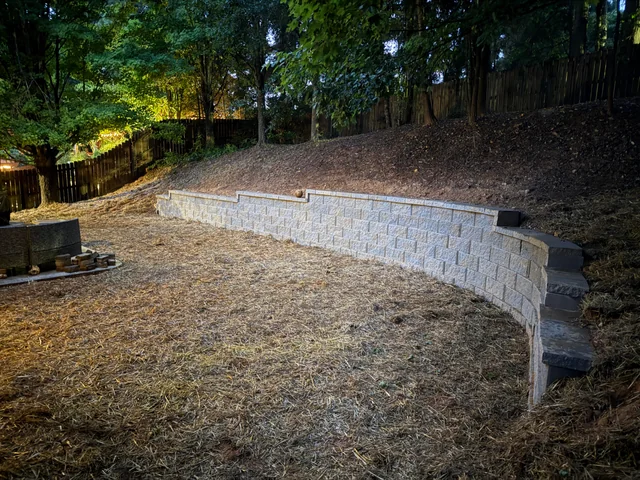
A driveway retaining wall is the hardest-working wall on your property. It holds back a slope while simultaneously absorbing the vibration, runoff, and freeze-thaw stress that comes from sitting right next to pavement. Built right, it lasts fifty years. Built like a garden wall, it fails in five.
We've rebuilt more driveway walls on Long Island than any other wall type — usually because the original contractor treated them like a standard landscape wall and skipped the engineering that road-adjacent walls actually require. Here's what sets them apart, what they cost, and what to insist on before signing a contract.
Why driveway walls are a different category
Three factors make a driveway wall fundamentally different from a backyard garden wall:
Surcharge load
A driveway carries vehicles. Even if the car isn't parking directly against the wall, the weight of traffic on the pavement transmits lateral pressure into the soil behind the wall — a force engineers call surcharge load. A wall designed only for soil pressure will be undersized by 30–50% when surcharge is factored in. This is why the engineering matters: a reputable contractor will either calculate surcharge manually or use published tables from the block manufacturer. Anyone who eyeballs a driveway wall design is gambling with your money.
Water concentration
Driveways shed water fast. Rain that falls on 1,000 square feet of pavement doesn't soak in — it runs to the edges and concentrates right at the base of the wall. If the drainage system behind the wall isn't built to handle that volume, hydrostatic pressure builds up, the wall bulges, and within a few freeze-thaw cycles it's failing. A 4-inch perforated drain at the base of the wall is the minimum. On slopes with long driveway runs, we typically add a catch basin or area drain to intercept flow before it reaches the wall at all.
Frost line proximity
Long Island's frost line sits at about 36 inches. Most landscape walls can get away with a shallower base because they're away from pavement and have better drainage. A driveway wall base should be at or below frost line — paved surfaces accelerate freeze-thaw cycles and the base needs to account for it. Contractors who cut to 18 inches on a driveway wall because "it works fine in the backyard" are setting you up for a heaved, cracked wall within three winters.
Material choices for driveway walls
Not every wall material is appropriate for driveway applications. Here's how the main options stack up:
Cambridge or Nicolock segmental block
Our go-to for most driveway walls. Engineered block systems are designed to handle surcharge and can be spec'd precisely for the loads involved. They're also the most forgiving to work with on tight urban lots where access is difficult. Expect $90–$160 per linear foot for a standard 3–5 ft wall, including drainage and base prep done correctly.
Natural stone
Looks exceptional, lasts forever when built properly. The limitation is that a mortared stone wall requires a poured concrete footing — which means excavation, formwork, and cure time before the wall goes up. More expensive and time-consuming, but the right answer on properties where aesthetics matter and budget allows. Dry-laid stone is not appropriate for driveway applications; the surcharge load will eventually work it apart.
Pressure-treated wood (timber walls)
We don't recommend wood for driveway walls. The combination of road salt in runoff, concentrated drainage, and surcharge load eats timber walls fast. We've replaced fifteen-year-old wood driveway walls that were supposed to last thirty. If budget is tight, spend a little more and do Cambridge block rather than wood next to pavement.
What a driveway wall project actually involves
For a typical 40-linear-foot driveway wall at 4 feet tall on Long Island's North Shore, here's what the work looks like:
- Layout and excavation: 1–2 days. We're cutting back into the hillside and removing soil, sometimes in tight quarters alongside an active driveway.
- Base preparation: Half a day. Compacted gravel base, minimum 8 inches, deeper if soil is soft.
- Drainage installation: Perforated pipe wrapped in filter fabric, gravel backfill, daylight outlet at each end of the wall. Non-negotiable on a driveway wall.
- Block installation: 2–3 days for a standard 40 ft run at 4 ft height, including geogrid placement if required (typically required at 4 ft and above).
- Backfill and grading: Final compaction, slope grading to direct surface water away from the wall.
- Cleanup: We haul everything — excavated soil, old wall material if demo was involved, packaging. The driveway should be usable the day we leave.
Permits: when do you need one?
On Long Island's North Shore, the general rule is that walls over 4 feet require a building permit. Driveway walls have one additional trigger: if the wall is within a certain setback from the road right-of-way, your municipality may require a permit even at lower heights. Huntington, Smithtown, and Oyster Bay all have slightly different rules on this.
We handle the permit application for you on any project that requires one. Don't let a contractor talk you out of pulling a permit on a driveway wall — it will come up at resale, and an unpermitted wall that's failed is a serious negotiating liability.
What to look for in a quote
A proper driveway wall quote should include, as separate line items:
- Excavation and hauling
- Base gravel and compaction
- Block material (with manufacturer and product specified)
- Drainage — pipe, gravel, and fabric listed separately
- Geogrid (if wall is 4 ft or taller)
- Labor
- Permit allowance (if applicable)
If you get a one-line quote that says "driveway wall, 40 linear feet, $X," walk away. You have no idea what's included and no leverage if corners get cut. We always provide itemized quotes — if you want to see an example of what a full breakdown looks like, read our piece on what a $34,200 retaining wall actually costs.
Timeline and disruption
Most homeowners worry about how long the driveway will be out of service. For a standard residential driveway wall, expect 4–6 working days total. We typically keep one lane usable or coordinate a start-of-day schedule so you can park before the crew arrives. If your driveway is the only access to a garage or you work from home, tell us upfront and we'll schedule around it.
On tiered or particularly long runs — 80 feet or more — we may need up to two full weeks. We'll be clear about the timeline in the quote so there are no surprises.
The bottom line
Driveway walls aren't glamorous, but they're one of the most consequential walls on a North Shore property. A failed driveway wall means a compromised slope, potential pavement damage, and a safety issue right at your front door. Done right, with proper drainage, the correct base depth, and block specified for the actual loads involved, a driveway wall should outlast the driveway itself.
We've built and rebuilt hundreds of them across Huntington, Cold Spring Harbor, Stony Brook, Northport, and the broader North Shore. If yours is showing signs of distress — bulging, cracks, leaning toward the pavement — get it looked at before winter. Freeze-thaw is hard on a stressed wall, and what's a repair in October can become a replacement in March.