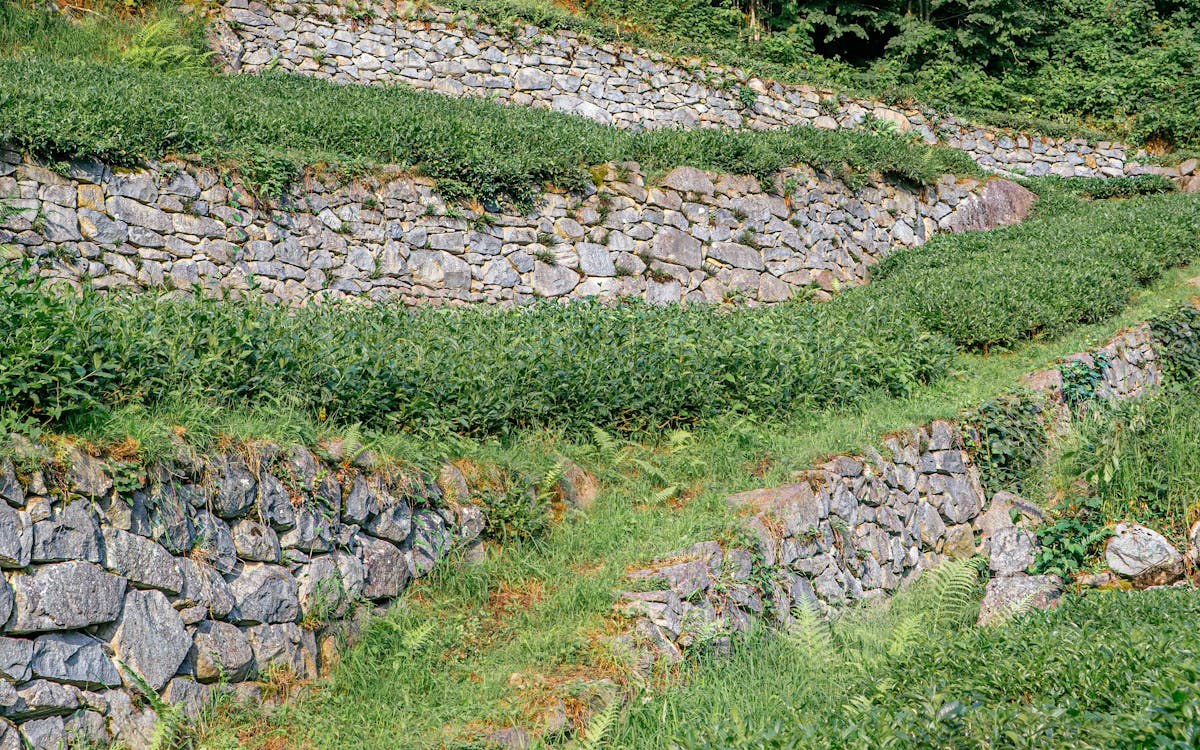
A retaining wall is a serious investment. Before you spend $10,000 or $50,000 on one, it's worth asking honestly whether your slope actually needs a wall at all — or whether a regrade, a drainage upgrade, or just smart planting could solve the same problem for less money. Here are the five questions we ask on every site visit.
This is the one article on this site that might cost us a job. We're okay with that. About one in ten properties we visit doesn't actually need a retaining wall — they need something cheaper and simpler. We'd rather tell you that and earn your trust than sell you a wall you didn't need.
Question 1: Is the slope actually moving?
The most important question. A slope that has been stable for fifty years doesn't suddenly need a wall just because someone said it's "steep." Look for actual evidence of movement:
- Soil collecting at the bottom of the slope after storms
- Exposed roots where soil has washed away from trees
- Cracks or step-offs in the lawn or planting beds running across the slope
- Bare patches that won't hold seed or plantings
- Trees leaning downhill or starting to lean
If the slope is showing none of these signs and isn't bothering you visually, you might not have a problem at all. If it's showing two or three, you have an active erosion situation that needs intervention — though not necessarily a wall.
Question 2: Where does the water go?
This is often the actual problem dressed up as a slope problem. A surprising number of homeowners come to us thinking they need a retaining wall, when what they actually have is a drainage problem causing erosion. Walk the property after a heavy rain and watch where water flows.
If water is sheeting off a steep section because there's nowhere for it to soak in, the cheapest solution is often a French drain or surface swale at the top of the slope, paired with better plantings. Cost: $2,000–$6,000 for most residential lots. A retaining wall on the same slope might run $15,000–$40,000.
Question 3: Is the slope steep enough to actually need structural support?
Slopes under about 3:1 (3 feet horizontal for every 1 foot vertical, or roughly 18°) generally don't need structural retention if the soil is decent. They might need erosion control — which can be plantings, jute mesh, or terraced garden beds — but they don't need a structural wall.
Slopes between 3:1 and 2:1 (about 18° to 27°) are the gray zone. Some need a wall, some don't, depending on soil, water, and what's at the top. This is where a real site visit makes the call.
Slopes over 2:1 (steeper than 27°) almost always need structural retention, especially on the North Shore where freeze-thaw cycles work against unprotected slopes every winter.
Question 4: What's at the top of the slope?
The same slope can be totally fine — or absolutely require a wall — depending on what sits at the top of it. The closer something valuable is to the top edge of the slope, the more important retention becomes.
- Open lawn: probably fine without a wall
- Garden beds, mature trees: probably benefits from a small wall but isn't urgent
- Driveway, walkway, patio: needs a wall before the hardscape starts to crack
- Pool, deck, shed: definitely needs a properly engineered wall
- House foundation within 15 ft of the slope edge: not optional — get a wall
Question 5: Are you trying to gain usable space?
This one flips the question. Sometimes the slope is fine — but you want flat yard, a level patio, a place to put a garden or a play area. In that case, a retaining wall isn't about preventing failure; it's about creating something you don't currently have. That's a perfectly good reason to build one. Just be honest with yourself that it's a lifestyle investment, not a structural necessity, and budget accordingly.
Tiered Cambridge or Nicolock walls are particularly good for this — you can convert a steep, unusable slope into two or three flat, usable terraces. We've turned 30° hillsides on Long Island into outdoor living spaces that feel like a different property.
The honest answer for most homeowners
If your honest answers above point to: stable slope + good drainage + nothing valuable at the top + no desire for new flat space — you probably don't need a wall. Save your money and re-plant the slope.
If your answers point to: actively eroding + drainage issues + something at risk at the top + or you want usable yard — get the wall. Build it once, build it right, and stop worrying about it.
And if you're somewhere in between, that's exactly what a free site visit is for. We'll walk it with you, tell you what we see, and either recommend a wall or recommend something cheaper. We'll tell you the truth either way.