If you're shopping for a retaining wall on Long Island, you've probably seen quotes that look like "Retaining wall — $32,000" with no other detail. That's not a quote. That's a number. Here's what an actual itemized retaining wall invoice looks like, line by line, from a real 2024 Centerport job.
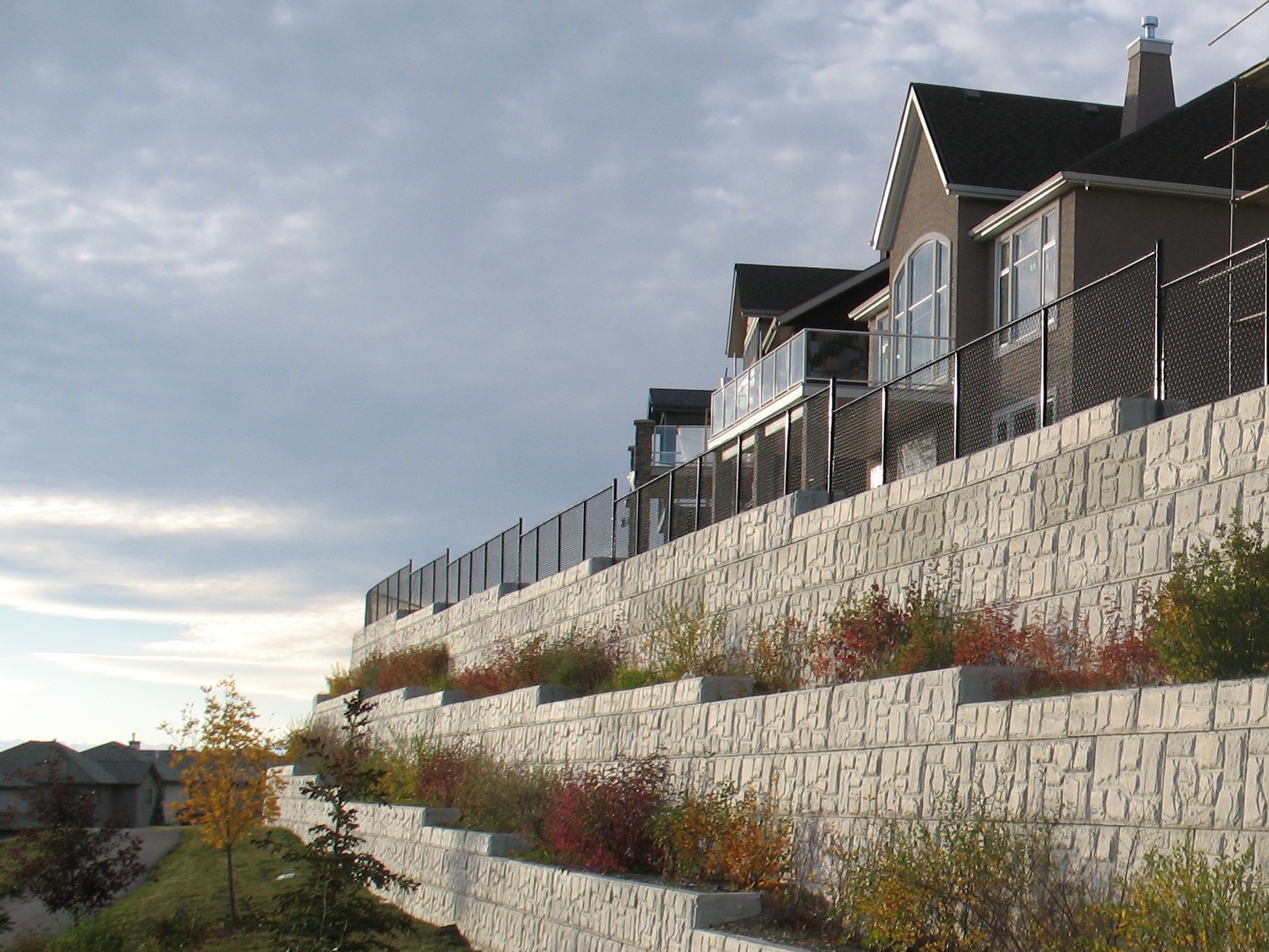
The job: 80 LF tiered Nicolock Olde Greenwich wall, two tiers, replacement of a failing 1980s timber wall. Property is in Centerport, off Park Avenue, on a downhill slope toward Little Neck Bay. Permit required, engineer's stamp included. Final invoice came in at $34,200. Here's where every dollar went.
The complete itemized invoice
What I want you to see
Let me walk through what jumps out of that breakdown, because it's the same pattern in every real quote.
The block itself is roughly 30 percent of the total. $9,810 on a $34,200 job. People assume "the wall" is mostly the block. It isn't. The block is the part you can see, but the structural parts you can't see (drainage, geogrid, base prep, backfill labor) are roughly equal in cost.
Drainage is a meaningful line item. Fabric, stone, pipe, fittings, outlet: $3,240 of the total. That's almost 10 percent of the invoice, just for water management. When you see contractors quoting walls without drainage as a separate line, that 10 percent is what's missing.
Geogrid is cheap relative to its impact. $1,180 in material plus the additional backfill labor (~$1,200 of the $2,800 backfill line, since geogrid layers slow the lift-and-compact cycle). About $2,400 of the $34,200 total. Skipping geogrid saves the contractor $2,400 in costs but cuts the wall's lifespan roughly in half.
Permit and engineer is a real cost. $1,650 for the filing plus the PE stamp. Some contractors quote $500 to $800 here and lose money on it. Others ignore it entirely and pass the risk to the homeowner. Both are bad signs.
Labor and supervision is honest. 9 working days of crew time plus our own site supervision. About $2,250 in management on top of the per-line labor. This is what "we have a real crew that shows up" actually costs. Independent operators with no project management can quote lower here, but the trade-off is they may not show up consistently.
Why contractors don't itemize
Two reasons, and they're related.
First, an itemized quote is harder to write. You have to actually compute material quantities, time crew labor honestly, and price each line. A flat-rate quote takes 10 minutes. An itemized quote takes 90 to 120 minutes for a wall this size.
Second, an itemized quote is easier to compare. Two flat quotes at $30K and $34K look like one is just cheaper. Two itemized quotes show that the $30K version is missing geogrid, has 6 inches of base instead of 10, and is using corrugated drain pipe instead of rigid PVC. Same project on paper, very different walls in the ground.
If a contractor refuses to itemize a quote on a project this size, that's the answer to your question about whether to hire them.
What this wall is like three years in
The Centerport wall was completed in August 2024. As of this writing (early 2026), the owner sends us a photo every six months or so. No movement. No cracks. The native plants between the tiers have filled in. The drainage outlet at the bottom has water visible after rain, which is exactly what it should look like. Wall is doing its job.
For comparison, the timber wall it replaced lasted about 25 years before it was so far gone that the owner had to act. The new wall, at conservative estimates, should last 40+ years. The math: $34,200 / 40 years = $855/year amortized cost. Vs the timber wall's $19K / 25 years = $760/year, but with the certainty of a $20-30K replacement around year 22. The block wall, at 1.7x the timber price, is cheaper over any timeframe that matters.
Where the same wall could come in cheaper
If you read that invoice and thought "couldn't this be done for less?", the honest answer is yes, in a few specific ways.
- Single-tier instead of two-tier. A single 60 LF wall at higher max height would have come in around $26,000. Cheaper, but the two-tier design gave the owner planting strips and softer visual lines.
- Cambridge instead of Nicolock. Cambridge and Nicolock are price-equivalent in most years, but in 2024 Cambridge ran about 6 percent cheaper. Would have saved $600 to $800 here.
- Skip the planting line. $620 of native plants. Pure aesthetic.
- Owner-handled disposal. Some owners will rent a dumpster and dispose of old timbers themselves. Saves around $1,000.
What we wouldn't recommend cutting: drainage, geogrid, base prep depth, permit handling. Those are the cuts that turn a 40-year wall into a 10-year wall.
The takeaway
If you're shopping for a retaining wall, ask for itemized quotes. Compare line by line. The line items will tell you exactly which contractor is building a wall and which is building a sale.
If you'd like to walk through a quote you've already received, call us at (631) 792-6546. We'll read through it with you on the phone and tell you what's in there, what's missing, and what's optimistic. No obligation, no sales pitch.